
Why Workforce Management Apps Are Becoming the New Site Foreman
A house needs a lot of hands – carpenters, electricians, plumbers. Someone has to keep track of all of them. For years, that someone was a person with a clipboard, standing near the site office, half-guessing who actually turned up that day.
These days, that person is often an app. Construction sites in Australia are spread across suburbs, regional towns, mining routes, wherever the work is. Workers hop between jobs mid-week. A paper timesheet gets rained on, or just forgotten. A spreadsheet gets three versions floating around by Thursday. This is the gap workforce management apps quietly fill.
It is not a small industry either. In 2023-24, construction employed around 1.3 million people in Australia and made up 7% of the country’s GDP, according to the Australian Bureau of Statistics. Once numbers get that big, a whiteboard and a clipboard stop being a system; they become a liability.
What Are Workforce Management Apps?
Strip away the marketing, and they are fairly simple. Workers clock in from their phone, right at the gate. A manager can glance at a screen and see who is actually on site, not who was rostered on. Payroll runs itself in the background instead of someone re-typing numbers on a Friday afternoon.
Australian workforce management apps go further than hours, too. They handle rosters. They push safety alerts. They store licences and white cards and flag one the moment it lapses, rather than three weeks later, when an auditor asks for it.
Why Construction Companies Actually Need Them
Office work is predictable. A desk stays put. Construction is the opposite. Crews shift between sites. Shifts may change at short notice. Rain can wipe out a whole day’s plan. A decent app for construction companies bends with that. It updates the roster in real time and tells a worker where to turn up, without a foreman making twelve phone calls.
Compliance is the other pressure point. Sites here have to follow strict safety rules. A missed licence check is not just paperwork. It may even involve fines or someone getting hurt.
Apps for construction companies can automatically catch expired certificates. It sounds unglamorous. It is also one of the most useful things they do.
There is a labour angle too. Infrastructure Australia has projected a shortfall of 300,000 construction workers by 2027. So, every pair of hands added on a site matters more than it used to. Companies cannot afford to waste time on admin or double-booking a crew.
What Paper and Spreadsheets Actually Cost

Paper timesheets look cheap. However, there is a lot of hidden work. Someone collects them. Someone re-types them into a system, usually squinting at handwriting. Along the way, an hour here or there gets logged wrong. Nobody notices this until payday, when it is already a headache to fix.
Spreadsheets are not much of an upgrade. Two people open the same file; one overwrites the other. The whole sheet is wrong by lunchtime. Workforce apps sidestep this almost entirely. The worker enters their working hours from their own phone. It flows straight into payroll with nobody re-keying anything.
Choosing the Right One
Not every workforce app is built for a construction site. Plenty are really retail or office tools with a new logo. A construction site needs GPS clock-in. It needs an offline mode. It needs buttons big enough to press with a gloved hand in direct sun.
Local rules matter just as much as the interface. Award rates differ by state. Public holidays shift too. Superannuation has its own quirks. A good Australian workforce management app has this baked in. So, payroll does not involve re-checking calculations by hand every week.
Integration is easy to overlook. The app should talk to the accounting software. It should also talk to whatever project tool the business already runs. Otherwise, someone is still typing the same numbers twice. This defeats the whole point.
Beyond Just Clocking In
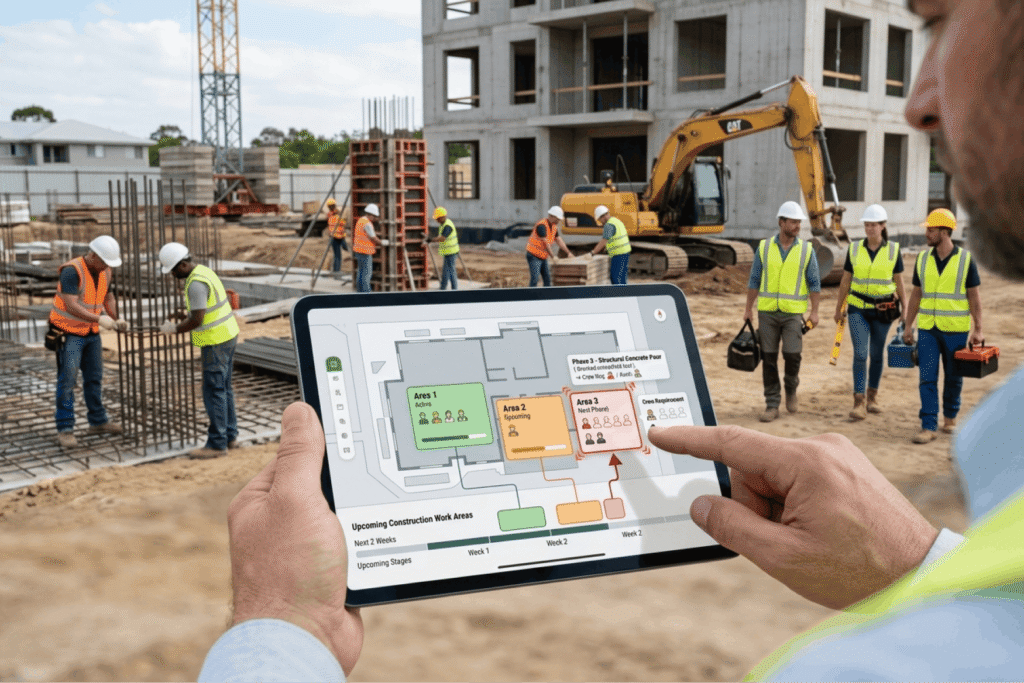
The better apps do more than track hours. They forecast labour needs for the next job. They flag a site that is understaffed before it becomes a crisis. Some apps even predict delays, based on nothing more than the labour patterns already sitting in the data. A site manager can pull in extra crew ahead of a deadline, instead of scrambling the week it slips. This was not simply possible with a folder of paper timesheets in a site office.
Small Builders Need This Just as Much
Initially, big building companies switched to apps. They had the budget to justify it. Small operators are slowly catching up. They arguably need it more. A crew of six still has payroll, licences, and rosters to manage, just with nobody spare to manage them. A phone-based app costs very little and saves hours.
Regional sites benefit even more. A project three hours from head office is hard to check on in person. An app closes that gap. Hours get logged on site. The office can see them, wherever they happen to be.
It Is Not About Replacing People
Some workers assume the app will replace the foreman. It is not, really. It just removes the parts of the job that made it inefficient. Like chasing timesheets or typing up rosters by hand. It was also tedious to double-check a licence that might have expired. Apps free a manager up for the parts of the job that actually need a person.
Workers tend to come around to it too, once they see the upside. Pay is more likely to be correct. Shifts are known in advance. Less time gets spent filling out forms nobody reads.
Conclusion
Australia’s construction industry is not slowing down. Labour is not getting any easier to find. Companies still running on paper will keep losing time to it. Those companies that have already switched over tend to make fewer scheduling mistakes. The sites are kept safer, almost as a side effect.
None of this is really new anymore. It is just becoming the ordinary way construction companies run a site, rather than the exception.
Let’s talk

Schedule a time for personalized analysis and solutions to scale your business effectively.



With more than 12 years in the game, we excel in delivering top-notch IT solutions tailored for medium-sized enterprises and large corporations. We're committed to your success, taking great pride in both our craftsmanship and the relationships we build with our clients.

Boost your Business Today by Teaming up with the Best!
1.5k Brochure Downloaded