How AI is Transforming Educational Mobile Applications?
- Personalised Learning Paths Replace One-Size-Fits-All Content
- Intelligent Tutoring and 24/7 Support
- Real-Time Feedback and Assessment
- Generative AI Is Cutting Content Creation Time
- Accessibility Features That Widen Who Can Learn
- Gamification and Engagement, Powered by Data
- Automating the Admin Work Behind the Scenes
- What This Means If You’re Building an Education App
- Where This Is Heading
- Conclusion
The most important reason for this is artificial intelligence, which will cause spending on education technology to rise from about USD 213 billion in 2026 to over USD 437 billion by 2033. What was once considered a “nice to have” feature is now the norm: students want apps that adapt to their needs, teachers want tools that save them hours of work, and parents want to be able to see their child’s progress.
AI is changing educational apps for phones in ways that aren’t just adding chatbots. It changes how content is made, how progress is tracked, who can get good learning, and how schools and edtech companies work.
If you’re building or investing in an education app in Australia or anywhere else, this is what you need to know about what’s going on and why it matters.
Personalised Learning Paths Replace One-Size-Fits-All Content
Individualisation on a large scale is the most important change that AI has brought to education apps. Adaptive learning engines let each student work at their own pace through the same curriculum. They do this by keeping track of how each student answers questions, how long it takes them, and where they get stuck. The app then changes the level of difficulty and the content in real time.
If a student does well with fractions, they are pushed to learn more difficult things. A student who is having trouble gets more practice, a different way of explaining things, or a simpler format, all without the teacher having to change the whole lesson plan by hand. This is the same idea behind Netflix suggestions or Spotify playlists, but this time it’s used for learning instead of fun.
Intelligent Tutoring and 24/7 Support
Natural language processing-based AI tutoring features let students ask questions in everyday language and get answers right away, even if it’s 11 p.m. and no teacher is available or it’s the weekend. These aren’t scripted FAQ bots; newer versions can walk a student through a math problem step by step, explain a grammar rule in a different way if the first one didn’t make sense, or give a quiz on a subject they just learned.
One real way for education companies to set their products apart is to make apps that can act as patient, always-available tutors. This is a much better value proposition than apps that are just digital worksheets.
Real-Time Feedback and Assessment
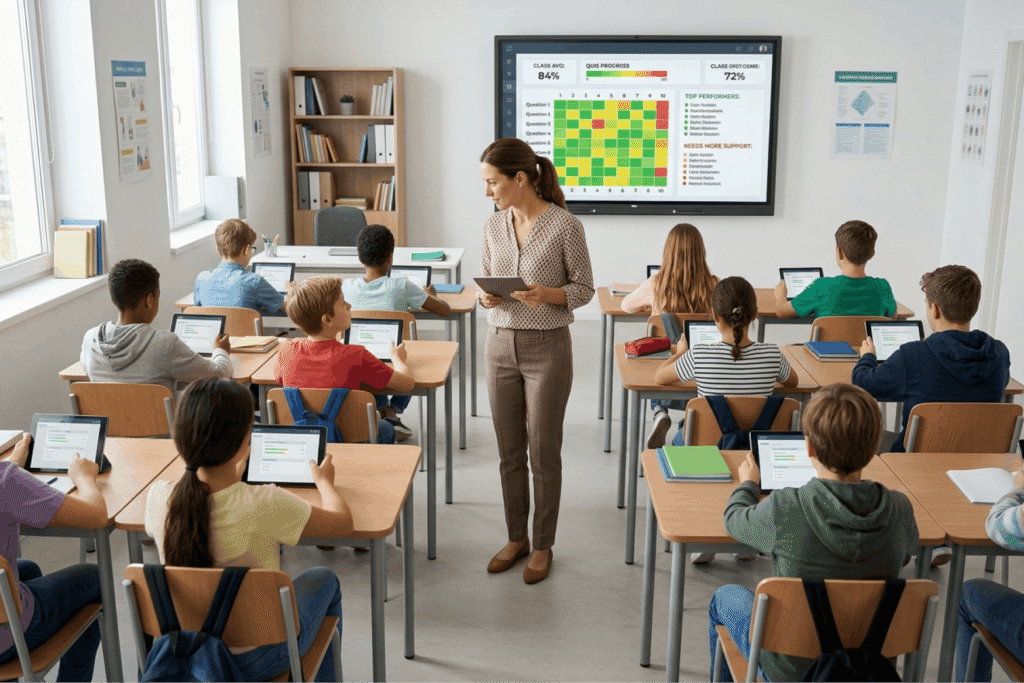
When students turn in work for traditional assessment, they have to wait days for a grade. AI immediately ends that loop. Apps can now mark right away on multiple-choice and short-answer questions, show students when they’re getting something wrong, and give them more than just a score.
This means dashboards for teachers that show them which students are falling behind and where they should focus their next lesson. This turns raw usage data into decisions instead of just reports.
Generative AI Is Cutting Content Creation Time
It used to take a long time and cost a lot of money to make good learning content. That’s changing thanks to generative AI. Teachers and people who make courses can now write lesson plans, practice questions, quizzes, and even translations into multiple languages in a lot less time. In fact, the time it takes to create content can drop by as much as 70%, according to estimates.
This is also important for business: edtech companies can add more courses and update materials without having to raise prices by the same amount.
Accessibility Features That Widen Who Can Learn
AI has made accessibility a feature that isn’t just added on for show. Students who have trouble reading or seeing can use speech-to-text and text-to-speech tools to get the same information as everyone else.
Real-time translation helps people who are learning a second language. Voice interaction takes away barriers for younger students who aren’t sure how to type yet.
This is one of the best things about AI in mobile learning: it makes apps easier for more people to use, not just smarter.
Gamification and Engagement, Powered by Data
There have always been points, badges, and streaks, but AI has made them smarter. Instead of giving out random rewards, apps can use information about how a student acts to figure out what really motivates them. They can then tailor challenges, reminders, and rewards to each student. This leads to personalised engagement instead of generic engagement, which is important for retention in a market where students (and parents) quickly delete apps if they lose interest.
Automating the Admin Work Behind the Scenes
AI can be seen by more than just students. Behind the scenes, the app automates tasks like scheduling, tracking attendance, grading, and reporting that would normally take a teacher or administrator all day. By freeing up that time, teachers can focus on teaching and helping students instead of doing paperwork, which is often what stops teachers from using technology in the classroom.
What This Means If You’re Building an Education App

AI features are no longer fancy extras that businesses and schools that want to make their own app should know about; users expect them. That means having adaptive content, smart tutoring, real-time analytics, and accessibility built in from the start, not added on later.
The cost of development depends on how advanced the AI layer is. The costs range from a simple MVP with basic personalisation to a full platform with predictive analytics and tools for making content on the fly. The best way to teach depends on who you’re teaching, whether they are K–12 students, college students, or people in corporate training.
Where This Is Heading
The next big thing in AI for educational apps will be highly customised learning tools that change based on how engaged students are, immersive AR/VR lessons, and real-time classrooms with students speaking different languages. None of this is just a theory; the building blocks are already in the tools used to make apps today.
Conclusion
Mobile educational apps are changing from static content libraries to responsive, personalised learning tools that change based on real students in real time thanks to AI. The chance for schools, edtech founders, and businesses looking into this area isn’t just to add AI, but to rethink what the app can do for the people who use it.
When you want to make or improve an AI-powered education app, App Gurus can help you with everything from the planning stages to the launch. Talk to our team about what you can do with your app.
Let’s talk

Schedule a time for personalized analysis and solutions to scale your business effectively.



With more than 12 years in the game, we excel in delivering top-notch IT solutions tailored for medium-sized enterprises and large corporations. We're committed to your success, taking great pride in both our craftsmanship and the relationships we build with our clients.

Boost your Business Today by Teaming up with the Best!
1.5k Brochure Downloaded